Unruh Effect Detected: Accelerating Space Emits Warmth
For decades, the Unruh effect has stood as one of the most intriguing predictions in theoretical physics, suggesting that an accelerating object would perceive the vacuum of space as a warm glow. Yet its extreme subtlety has placed direct observation firmly out of reach—until now. A collaborative team from Stockholm University and IISER Mohali has proposed a groundbreaking experimental strategy that could finally bring this elusive phenomenon into the laboratory.
From Theoretical Whisper to Detectable Signal
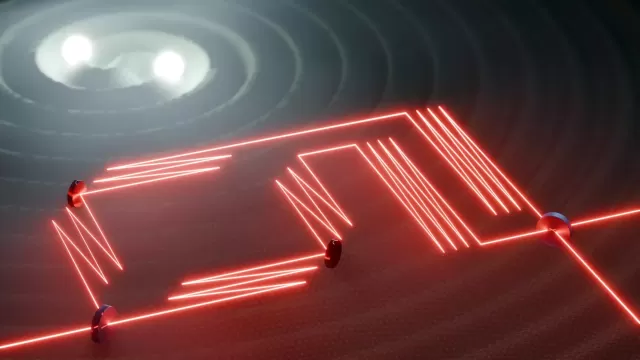
The core challenge has always been the staggering acceleration required—far beyond any practical experiment. The new approach cleverly circumvents this by transforming the Unruh effect's faint thermal whisper into a distinct, timed optical signal. The design involves positioning a collection of atoms within a cavity formed by two parallel, high-quality mirrors. This environment fundamentally alters how the atoms emit light, coaxing them to act in concert rather than individually.
This synchronized emission, known as superradiance, results in a powerful, collective flash of light—much brighter than the sum of its parts. The researchers' key insight is that the subtle thermal influence predicted by the Unruh effect would minutely shift the atoms' behavior. This shift causes the superradiant flash to occur measurably earlier than it would without acceleration. The timing of the light burst becomes the clear signature, turning an impossibly weak heating effect into a detectable temporal shift.
Why Precision Timing is the Key to Isolation
A primary advantage of this method is its dramatic reduction in the required acceleration. The high-quality mirrors serve a dual purpose: they amplify the collective atomic response while suppressing ordinary background optical noise. By focusing on the precise moment of emission rather than attempting to measure an infinitesimal temperature change, the protocol isolates the target signal from the overwhelming clutter of everyday experimental interference.
This focus on a "clock-like" marker provides a cleaner pathway to verification. The early arrival of the superradiant pulse acts as a direct fingerprint of the Unruh effect, offering a new paradigm for detection that relies on chronology over intensity.
Bridging the Gap to Extreme Physics
Successfully implementing this proposal would achieve a long-sought goal in modern physics, effectively bridging the gap between tabletop experiments and phenomena associated with the most extreme cosmic environments. Furthermore, because acceleration is intimately connected to gravity through Einstein's equivalence principle, this research opens a promising avenue for investigating quantum gravitational effects in controlled laboratory settings.
The development of such timing-based techniques could eventually allow scientists to probe the delicate interplay between quantum mechanics and gravity, moving these profound questions from the realm of abstract theory to the experimental bench.
The findings, detailed in a recent publication in Physical Review Letters, mark a significant step toward observing one of physics' most subtle effects, demonstrating how ingenuity in experimental design can illuminate the deepest corners of our universe.