
Nvidia's China Strategy: A Balancing Act Between Export Restrictions and AI Growth
Nvidia, a titan in the artificial intelligence (AI) arena, has experienced meteoric growth, with its stock price surging over 1,000% since the beginning of 2023. This surge is fueled by robust demand for its advanced GPUs and other data center infrastructure, which are essential for AI development and deployment. However, U.S. government-imposed export restrictions have significantly impacted the company's sales and market position in China, a historically crucial market. Recent developments suggest a potential shift in policy, which could have major implications for Nvidia's future growth.
The Impact of Export Restrictions on Nvidia's China Business
China has been a vital source of revenue for Nvidia. In fiscal year 2022, it accounted for 26% of the company's total revenue. However, U.S. export restrictions have gradually reduced this percentage. By fiscal year 2025, China's contribution had fallen to just 13%. Concurrently, Nvidia's market share in China's AI chip market has shrunk from a dominant 95% to approximately 50%, according to CEO Jensen Huang.
To better understand the evolution of U.S. policy and its impact on Nvidia, consider the following timeline:
| Date | Action | Impact on Nvidia |
|---|---|---|
| September 2022 | The Biden administration restricts the export of A100 and H100 GPUs to China. | Nvidia estimates a loss of $400 million in quarterly revenue. |
| October 2023 | The Biden administration further restricts the export of H800 GPUs to China. | Nvidia is forced to cancel billions of dollars in orders. |
| April 2025 | A hypothetical new administration restricts the export of H20 GPUs to China. | Nvidia faces a $4.5 billion charge and expects to lose $8 billion in revenue during the second quarter. |
These restrictions have not only directly impacted Nvidia's revenue but also raised concerns about the long-term consequences for the company's competitive positioning. CFO Colette Kress highlighted the potential loss of access to China's growing AI accelerator market, estimated to be worth nearly $50 billion, which could significantly harm Nvidia's business and benefit its competitors.
Jensen Huang has been vocal about his disapproval of the export restrictions, arguing that they stifle innovation and strengthen Chinese chipmakers at the expense of American companies.
A Potential Policy Shift: H20 GPU Sales and the AI Diffusion Rule
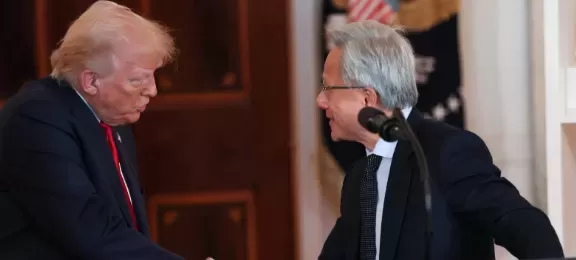
Recent developments suggest a possible change in policy. Nvidia has filed applications to resume selling its H20 GPUs in China and has received assurances from the U.S. government that the necessary licenses will be granted. This news followed a meeting between CEO Jensen Huang and a high-level official.
Additionally, the AI Diffusion Rule, introduced during the previous administration, has been revoked. This rule would have restricted Nvidia's ability to sell advanced AI chips to numerous countries, including key U.S. allies like Saudi Arabia, the UAE, Singapore, and Israel. The revocation was justified on the grounds that the rule would have stifled American innovation, burdened companies with excessive regulations, and damaged diplomatic relations.
Capitalizing on New Opportunities: Sovereign AI and Global Partnerships
Nvidia is already capitalizing on the rescission of the AI Diffusion Rule. With more countries investing in sovereign AI infrastructure – data centers wholly owned and controlled by the nation itself – Nvidia has secured partnerships to supply its chips and networking equipment to countries such as Saudi Arabia and the UAE.
Implications for Investors: Analyst Expectations and Stock Valuation
The policy shift, allowing H20 GPU sales in China and rescinding the AI Diffusion Rule, expands Nvidia's total addressable market. This is likely to prompt Wall Street analysts to revise their earnings estimates upward, which typically leads to share-price appreciation.
Currently, consensus estimates project Nvidia's earnings to grow at an annual rate of 41% through fiscal year 2027. This growth rate makes the current valuation of 54 times earnings seem reasonable. However, positive revisions to earnings estimates would make the stock even more attractive to investors.
Weighing the Risks and Rewards of Investing in Nvidia
Nvidia presents a compelling investment opportunity due to its leadership in the AI market and its potential for continued growth. The easing of export restrictions could unlock significant revenue opportunities in China and other global markets.
However, investors should also be aware of the risks involved. The geopolitical landscape remains uncertain, and future policy changes could negatively impact Nvidia's business. Additionally, the company faces increasing competition from other chipmakers, both in the U.S. and abroad.
A Dynamic Environment for Nvidia
Nvidia operates in a dynamic environment shaped by technological innovation, geopolitical tensions, and evolving regulatory policies. While the company has faced challenges due to export restrictions, recent developments suggest a potential easing of these restrictions, which could provide a significant boost to its revenue and market position. Investors should carefully consider both the risks and rewards before investing in Nvidia, but the company's long-term growth prospects remain promising.
Disclaimer: This article is for informational purposes only and should not be considered as financial advice. Always conduct thorough research and consult with a qualified financial advisor before making any investment decisions.